
Happy Sunday! What a week of sports. March Madness paired with the start of Major League Baseball season has been a lethal one-two punch to the productivity department, but we’re powering through.
For the first time ever, I ended up doing a drawing every single day this past week. Very kindergarten core.
Also made it out to Opening Night with MLB, where they had one of the coolest flag features I’ve ever seen.

Projects we did this week 📅
Why March Madness is so Special - IG, TT, YT
Tennis players vs Grand Slams - IG, TT, YT
The next phase of the X Games - IG, TT, YT
MLB ABS explained - IG, TT, YT
How NBA expansion works - IG, TT, YT
As always, we have prints of every page I draw at our print shop here
Spotlight: MLB ABS
A few weeks ago, I got looped into a project with Major League Baseball around something you’re going to start seeing a lot more of this season.
Challenging balls and strikes.
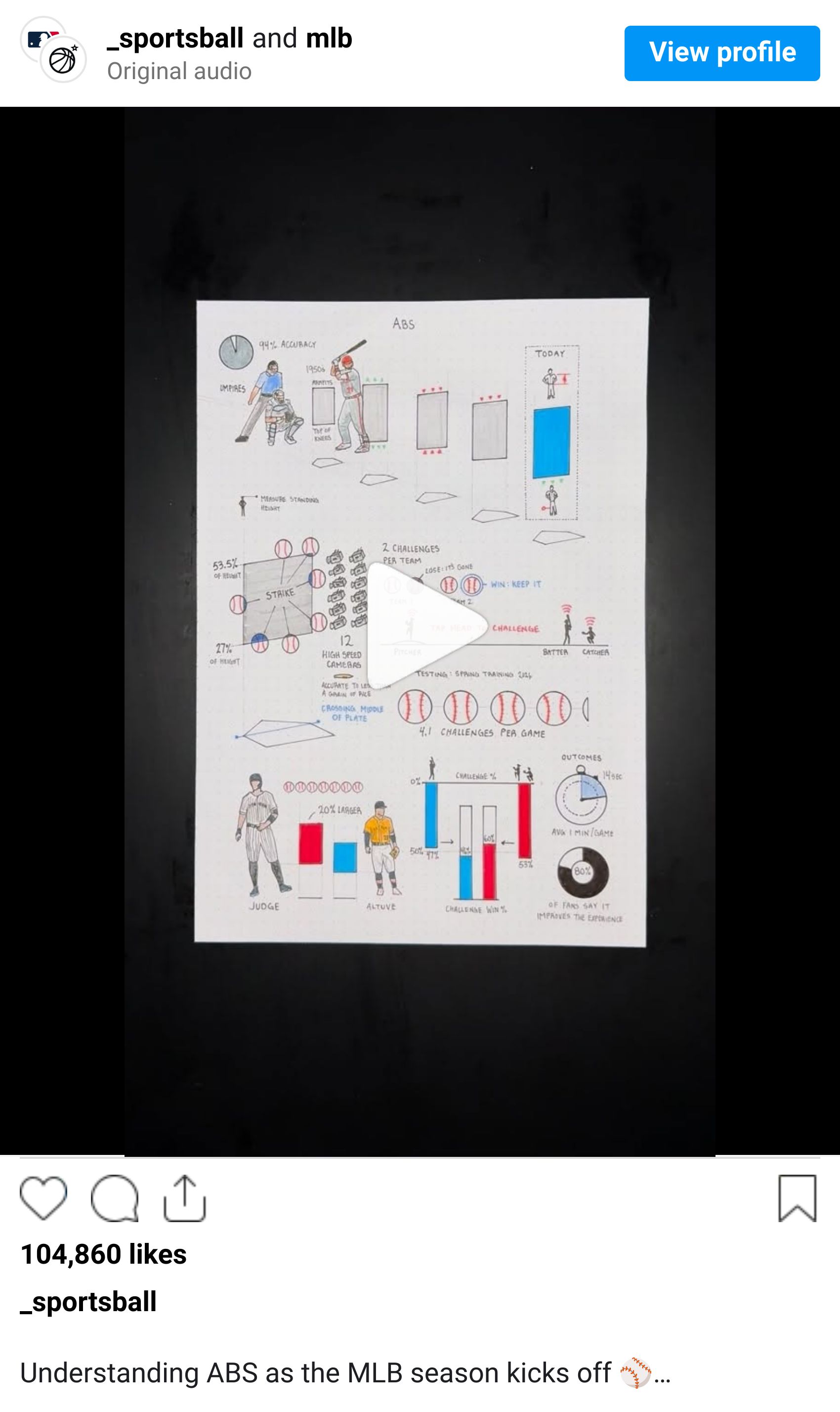
This isn’t brand new. MLB has been testing versions of this for years in the minors and spring training. But this is the first time it’s really being rolled out in a meaningful way at the major league level.
And the reason is pretty simple.
Umpires are really good. But they’re not perfect.

On average, they’re about 94% accurate calling balls and strikes. That sounds great until you realize that’s still 8 to 10 missed calls per game, and some of those can completely change the outcome. We saw that firsthand in the World Baseball Classic, where a missed strike call at the end of a game could have extended things and changed everything.
So the question becomes: how do you fix that without slowing the game down or turning it into a robot-run sport?
The Challenge System
The solution MLB landed on is actually pretty elegant.
Each team gets two challenges per game. If you win the challenge, you keep it. If you lose it, it’s gone. Only the pitcher, catcher, or hitter can initiate it, and they do it instantly by tapping their head. No dugout debates, no replay reviews dragging on.

Building a “Perfect” Strike Zone
The real lift here wasn’t the challenge system itself. It was defining a strike zone precise enough to actually review. In tennis, the ball hits a line you can see. In baseball, the strike zone is… kind of imaginary. So MLB had to build one.
They measured every player and defined the zone based on their height:
Bottom of the zone: 27% of a player’s height
Top of the zone: 53.5% of a player’s height
Width: exactly 17 inches, the width of home plate
Every pitch is judged as it crosses the middle of the plate, not the front.
Which means every single player has a slightly different strike zone. José Altuve’s is compact. Aaron Judge’s is massive. Roughly 20% larger by area, or about seven extra baseballs worth of space.
Same rules, completely different geometry.

The Data Behind It
To enforce that level of precision, MLB uses a system of 12 high-speed cameras tracking every pitch down to less than the width of a grain of rice.
From early data this season:
54% of all challenges are overturned
Pitchers and catchers initiate 53% of challenges
They’re also better at them, winning about 60–61% of the time
Hitters are down around 46%
That actually makes a lot of sense.
Catchers and pitchers have a straight-on view of the zone every pitch. Hitters are making split-second decisions from the side while also trying not to get hit by a 95 mph fastball.
Different vantage points, different results.

If you want to go deeper, MLB has a full Baseball Savant ABS dashboard where you can track all of this in real time. Who’s challenging the most, who’s getting them right, and even how far off certain calls are.
Some of the early ones have been obvious. Pitches 2–3 inches outside the zone getting overturned.
Others are razor thin.
So… Does It Work?
So far, pretty well.
Each review takes about 14 seconds, adding roughly one minute total to a game. And more than 80% of fans say it improves the experience. Which is kind of the whole goal.
What I like about this system is that it doesn’t try to make baseball perfect.
It just tightens the margins.
Umpires still call the game. Players just get a couple chances to say “hey… I don’t think that was right.” And now, for the first time, there’s a system precise enough to actually answer that question.
Project Sneak Peeks 🔜
🌊 Finally some surfing content
🎾 Retirement funds - sports edition
Hope everyone has a great week, and as always, feel free to respond with any feedback. We’re all ears.
More drawings soon.
— Riley & Claire
