
Happy Sunday! After a five-video sprint last week, we took the foot off the gas a bit, helped by the fact that we spent the week in Hawaii. Drawing graphs for three hours a day doesn’t exactly align with a strict beach and mai tai schedule.
That said, we still managed to get some work done on the page.

Projects we did this week 📅
As always, we have prints of almost every page I draw at our print shop here
Spotlight: How Pro Surfing Works 🌊
Being on an island, it felt only right to focus on the project that involves waves.
I’ve been working with the World Surf League, and what started as a deep dive into brackets and point systems quickly became something much more interesting. An explainer on how professional surfing actually works.
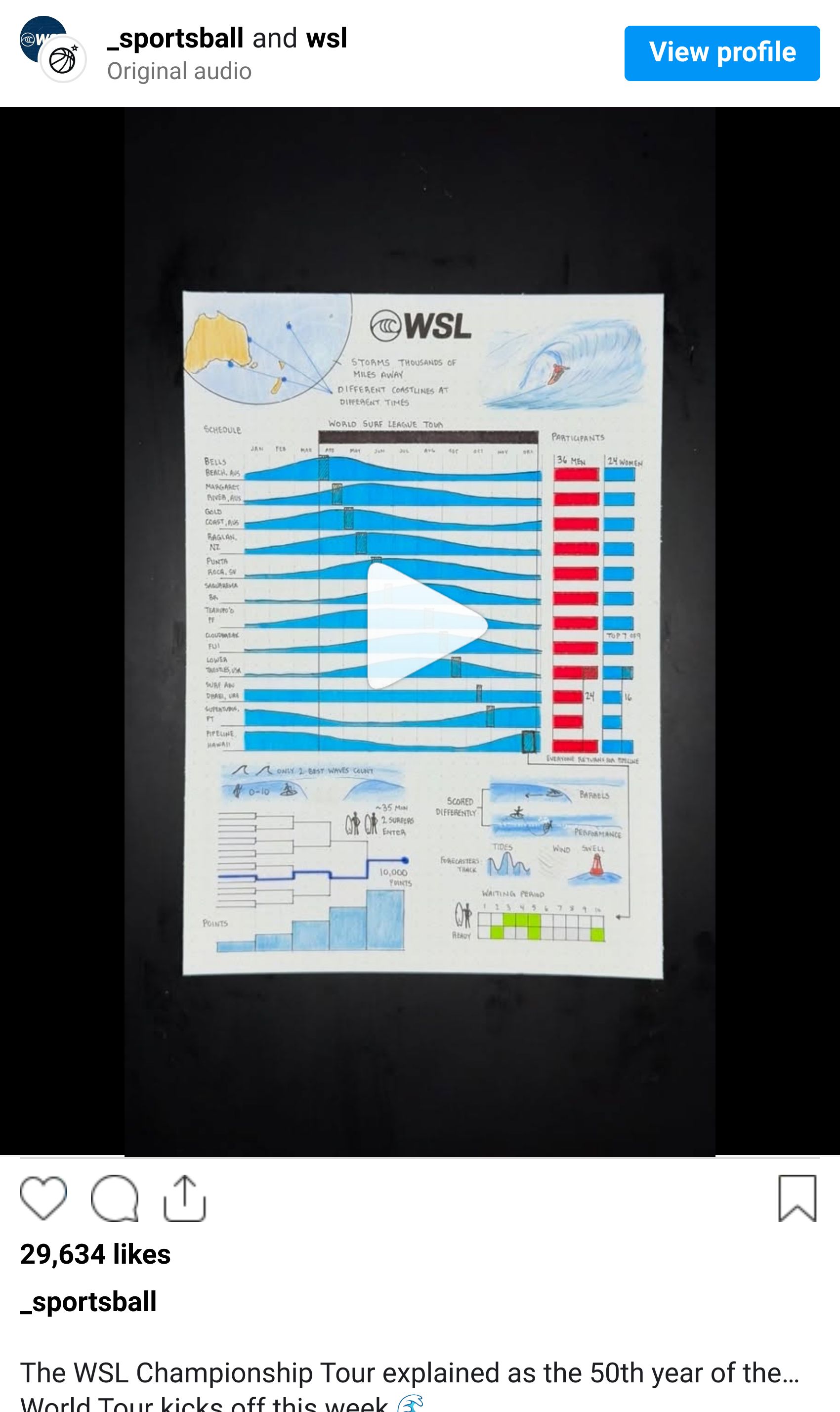
You see, most people haven’t grown up with a coastline on their doorstep. They may have seen a surfing film or two, but the mechanics of the sport are largely a mystery; so I proposed we zoom out and look at pro surfing from a more meta perspective.
How Do Waves Even Work?
Before getting into the tour itself, I had to get my head around the science.
What is a swell? Is the moon involved? How do storms near Brazil turn into six-foot barrels off the coast of Portugal?
I quickly came to learn that the sport is as much a professional weatherman tour as it is a pro surfing tour
The WSL works closely with surf forecasters, companies like Surfline, who can spot promising storm systems weeks or even months in advance. That forecasting is what makes the entire tour possible.
From my very basic college surfing days, I knew winters usually meant better waves. But I never really knew why.

Different regions, even along the same coastline, have completely different seasonal windows. The Southern Hemisphere kicks things off. Australia, New Zealand, and South America get their best swells during their spring and summer. As you move north, the timing shifts to autumn and winter.
It all comes down to where storms are forming and how far the waves have to travel to reach the break.
To visualize this, I built a wave-shaped seasonal diagram, where the peak of each wave represents the best time of year for that region. Then layered the WSL schedule on top to show how the tour moves around the world chasing those conditions.

A line I heard during the process stuck with me:
“We’re trying to put the best surfers in the best waves at the best time.”
That became the backbone of the whole piece.
The Most Unpredictable Calendar in Sport
Unlike almost every other major sport, the WSL doesn’t operate on a fixed schedule.
Each tour stop has a 10-day waiting period. When the swell, wind, and conditions all line up, the green light goes on and surfing happens.
Sometimes that means running multiple heats in a single day. Sometimes it means waiting around for days while the ocean refuses to cooperate.
The ocean floor plays a role too. Sand versus reef creates completely different types of waves. You get hollow, heavy barrels on one end and flatter, more technical waves on the other.

The best analogy I found was bull riding.
The bull gets a score, and so does the rider. If the bull doesn’t perform, neither can the rider.
Same thing here. If the waves are inconsistent for 35 minutes, that’s just bad luck. No judge can fix that.

How a Champion Is Decided
The tour runs from April through the end of the year, spanning 12 events across both hemispheres.
Only a surfer’s best 9 results count toward their total, which rewards consistency without punishing one bad event in poor conditions.
From there, the top surfers advance to the final events of the season, where the world champion is ultimately crowned.
Right now we’re actually in the middle of the first event in Bells Beach if you want to give it a look.
Project Sneak Peeks 🔜
⛳️ A tradition like no other
⚽️ Demotion in soccer
Hope everyone has a great week, and as always, feel free to respond with any feedback. We’re all ears.
More drawings soon.
— Riley & Claire
