
Happy Sunday!
We’re a few races into the Formula 1 season now, and something feels a little different. Same tracks, same drivers, still going absurdly fast, but the racing itself has clearly changed.

Projects we did this week 📅
As always, we have prints of almost every page I draw at our print shop here
Spotlight: What Changed in Formula 1 🏎️
Every few years, Formula 1 rewrites its rulebook.
New regulations, new cars, and new tradeoffs. This year, the changes touched almost everything, from aerodynamics to the engine, and more importantly, how drivers actually get around a lap.
The tricky part is that most of these changes are invisible to the naked eye unless you dig into the data. Candidly, it’s hard to tell the difference between 225 mph and 212, but that gap can make a huge difference once the racing starts.
Same Track, Different Reality
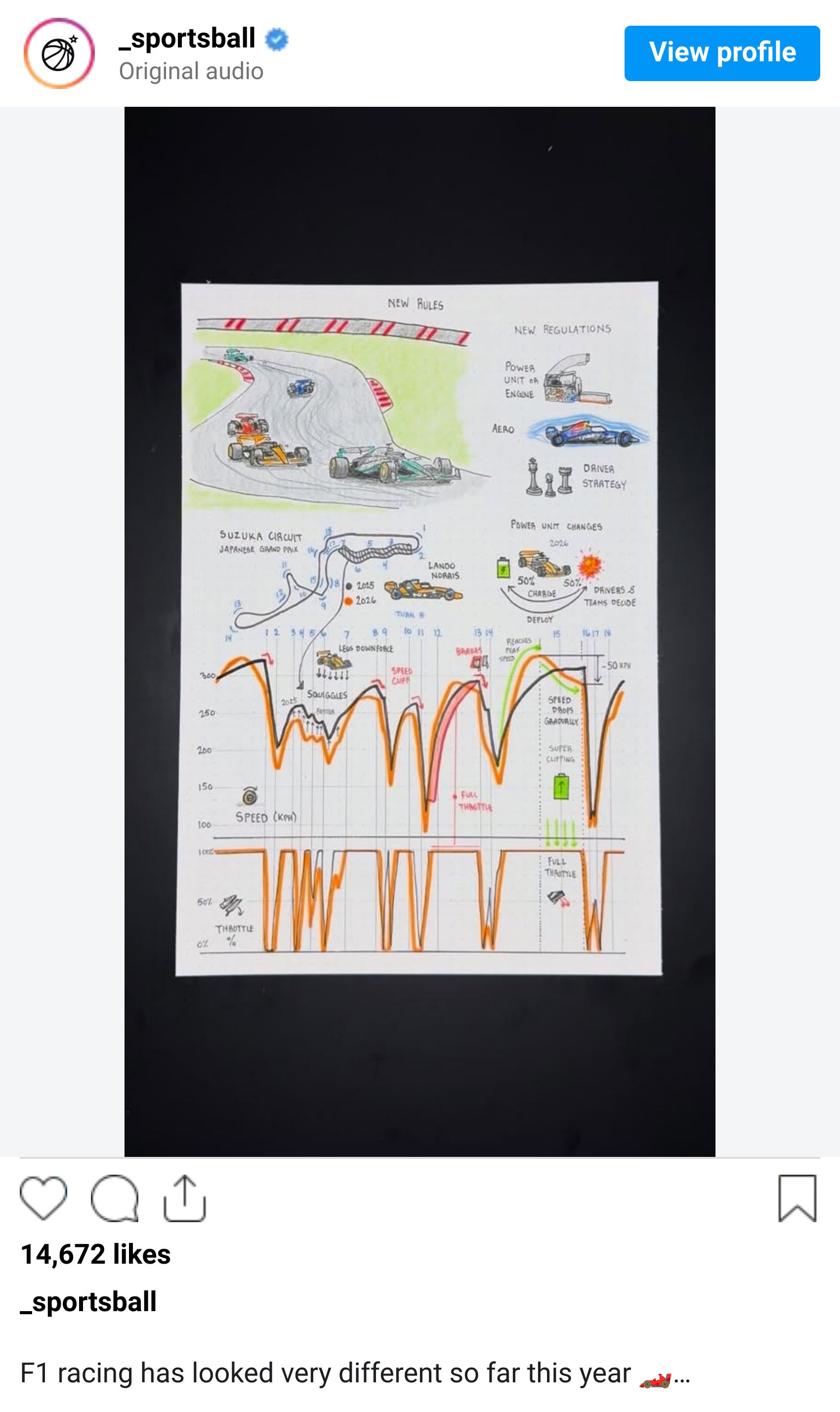
Take Suzuka as an example. Lando Norris ran a 1:26.995 lap here last year. This year, the fastest lap came in at 1:29.409, a +2.414 second difference on the exact same circuit.
In Formula 1 terms, that’s significant. It’s not something you necessarily feel while watching, but over the course of a single lap, those small changes compound quickly.

GP Tempo telemetry
Slower Where It Matters
A big part of that gap shows up in the corners. Through high-speed, technical sections like the S-curves, the new cars are as much as 20 km/h slower.
That’s the direct result of reduced downforce.
With less aerodynamic grip pushing the car into the track, drivers simply can’t carry the same speed through those flowing sections, even if everything else about the lap looks similar.

Orange is 2026 speed curve, black is 2025
Faster… Then Not
What makes this interesting is that the loss in the corners doesn’t really show up at the top end. Straight-line speeds are almost identical, usually within 1 to 3 km/h of last year.
But how the cars reach that speed has changed.
Out of corners, the new power units deliver a sharper burst of acceleration thanks to the electric component, so cars actually get up to speed faster than before.
Then, partway down the straight, something counterintuitive happens. Even with the throttle fully pressed, the car can begin to slow down. In some cases, drivers are losing around 50 km/h without touching the brakes or lifting off the gas.

Orange is 2026 speed curve, black is 2025
That comes down to energy management.
Instead of sending all available power to the wheels, the system redirects some of it to recharge the battery. So even when the driver is flat out, the car is effectively choosing to save energy.
That shift changes the nature of Formula 1. It’s no longer just about pushing as hard as possible at all times. Drivers and teams now have to think about when to deploy energy, when to harvest it, and how to manage that balance across an entire lap.
You’re not just racing the track anymore, you’re managing a system in real time.
Why This One Was Interesting
This is one of those projects where the numbers tell the story. A 2.4 second gap doesn’t look like much on paper, and 250 km/h versus 230 km/h looks identical on TV.
But once you understand where that time is being lost and how the car behaves under full throttle, it completely changes how you think about what you’re watching.
Project Sneak Peeks 🔜
⚾️ Let’s talk about salary caps
🏀 Tanking
🏍️ Silly season in MotoGP
Hope everyone has a great week, and as always, feel free to respond with any feedback. We’re all ears.
More drawings soon.
— Riley & Claire
